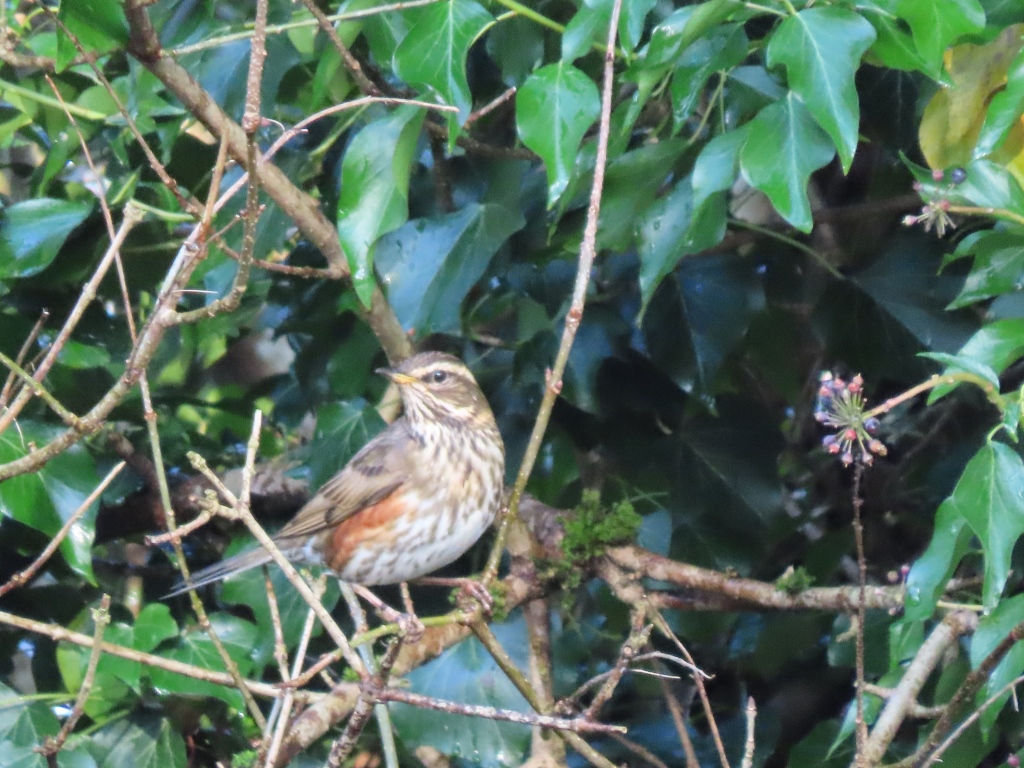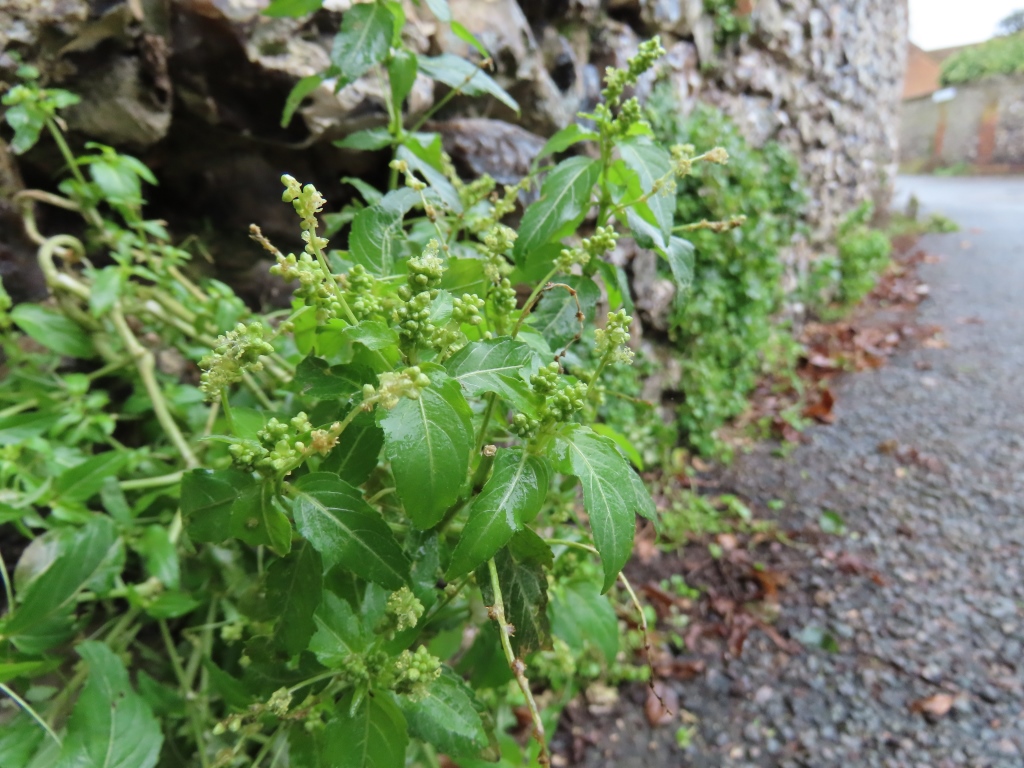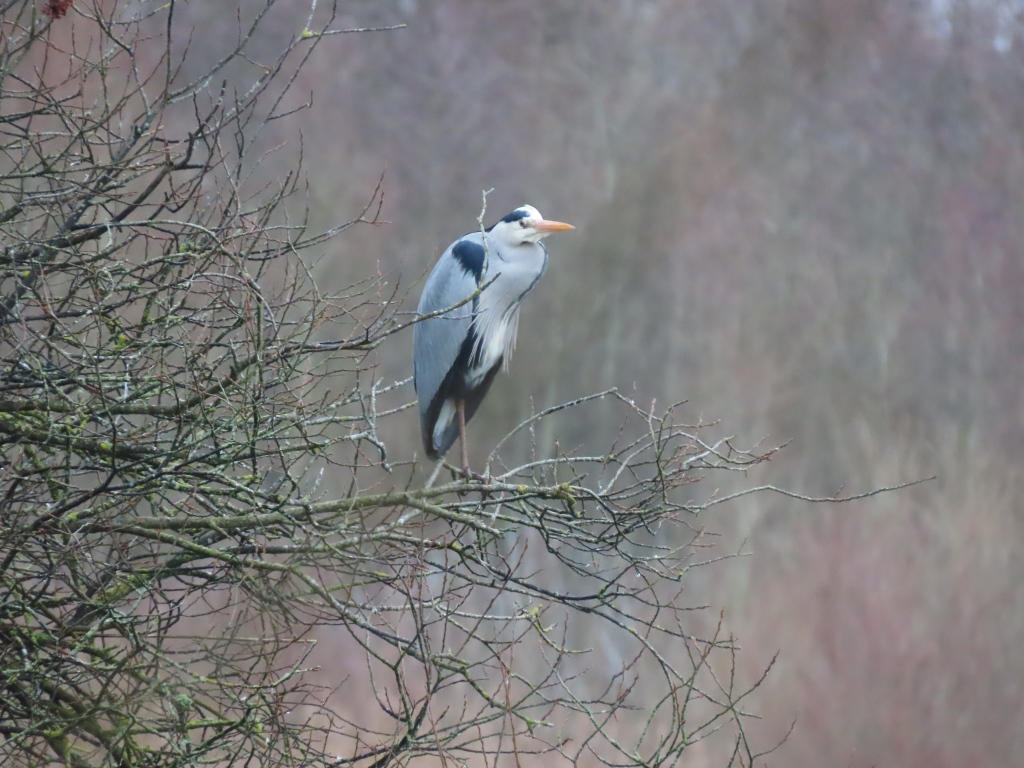
Fiona Brown led a circular walk which started from the car park of the King’s Head at Little Marlow on Wednesday 15 January. It was a grey morning with thick cloud cover, but the weather was relatively mild and there was no rain. Fiona challenged the walkers to see more than the 38 species of bird which she had counted on the pre-walk. The morning’s tally started with Robin, Wood Pigeon, Jackdaw and Redwing. The group turned right out of car park, then right again along a footpath which headed in a south-westerly direction. At the start of the footpath, Annual Mercury was in flower near the base of a wall on one side of the path and sweet-smelling Winter Heliotrope was in flower on the other side. A pair of Ring-necked Parakeets called loudly. An Egyptian Goose was standing in the middle of a field on the left. The path continued along a stretch where there were many Teasel seed heads. Most of the berries had already been stripped from the scattered Hawthorns which bordered the path. Birds seen here included Blackbird, Goldfinch, Chaffinch, Red Kite, Blue Tit and Great Tit. A Hazel by the path had yellow male catkins and red female flowers. A fallen branch was home to a clump of the Yellow Brain fungus Tremella mesenterica. A Kestrelwas spotted up in a tree and Dunnock and Fieldfare were added to the species tally. The path continued through the grounds of Westhorpe House where Snowdrops were already in flower. The next section of the route followed a path round the edge of a gravel pit, where Coot, Mallard, Shoveler, Tufted Duck, Great Crested Grebe and Moorhen were seen and a Great Spotted Woodpecker was heard. The path then crossed the single-track railway line to Bourne End. The crossing was controlled by red/green traffic lights. On the south side of the line was a grassy meadow which bordered the fast-flowing River Thames. Quarry Wood and Winter Hill could be seen across the river. This section of the route is part of the Thames Path. Two months earlier, the midweek walk had followed the Thames Path south from Moulsford. At every hauling out site beside the river there had been Crayfish bones and claws, left by Otters. There were no signs of Otters along this section of the River Thames. The Moles had been busy – there were freshly made mole hills in the rich soil of the riverside meadows. On her pre-walk, Fiona had seen a Fox here. Several Cormorants and a pair of Egyptian Geese flew past, following the river upstream. The next section of the walk was along a footpath over the meadow and then back over the railway line. Parts of the meadow had been covered by shallow floods which had then frozen. A chorus of crackles and crunches accompanied the walkers as they cautiously crossed the ice. The route led to Spade Oak Nature Reserve, which includes the largest gravel pit which has been landscaped with islands, varying depths of water, shallow margins and bankside trees. Herons were already nesting in willows near the path. One flew in and presented a twig to its mate which was sitting on its nest. A Little Egret was perched in the bankside willows further round the lake. Ducks seen included Gadwall, Teal, Shelduck and Pochard. A flock of Lapwings were roosting on a shallow shore. There were several Mute Swans and many Black-headed Gulls. Then a Kingfisher flew fast across a corner of the lake. The footpath led back to Little Marlow, initially with the lake to the right and some rather smelly sewage treatment works to the left. Just before reaching the village, Fiona pointed out where she had seen the star bird of her pre-walk, a Lesser Spotted Woodpecker. A count later in the pub revealed that Fiona had won the bird list challenge, seeing 38 species on the pre-walk, while the rest of the group had managed to see 35 species during the morning’s walk. Most of the group then stayed for lunch at the King’s Head.
Attended by 10