On Saturday 5 July, Grahame Hawker led 15 members on a walk at Knepp near Horsham in West Sussex. Grahame and his wife Lesley had been camping on the Knepp Estate for the previous few days of hot sunny weather, checking out in particular the best places to see Purple Emperor butterflies, which were having a good year. Unfortunately, the weather on Saturday was disappointing, with thick grey cloud, lower temperatures and occasional rain. Members gathered at the shop near the walkers’ car park, then regrouped outside while Grahame gave an introduction to the rewilding at Knepp. The 3500-acre Knepp Estate lies on deep clay which is like concrete in summer and sticky porridge in winter. Owners Charlie Burrell and Isabella Tree tried their hardest for about 12 years to improve and diversify the farm, but only succeeded in increasing their debts. In 2000, the sale of their dairy herd and arable
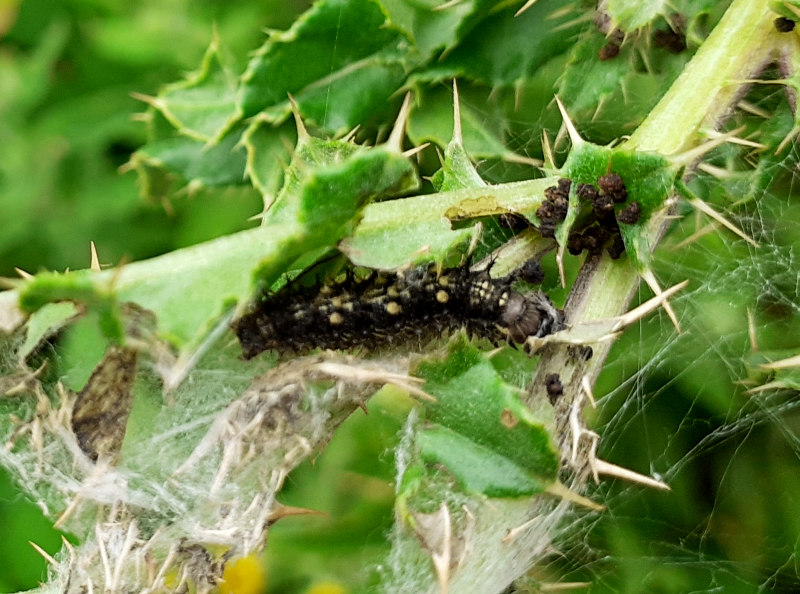
farming machinery cleared their debts and enabled them to start on the rewilding experiment. In 2003, changes to the EU’s Common Agricultural Policy allowed farmers to receive subsidies for taking agricultural land out of production. The walkers set off towards the camping area. A Humming-bird Hawk-moth was spotted feeding on a Buddleia bush. It was then seen egg-laying on yellow-flowered Lady’s Bedstraw, which was scrambling through the scrub around the Buddleia. The track led into a field whose vegetation was dominated by Common Ragwort, Common Knapweed and Common Fleabane, plus Common Centaury and Marsh Thistle. Stripy black and yellow caterpillars of the Cinnabar moth were feeding on the ragwort. A Marbled White butterfly was spotted resting with its wings together. A flock of Goldfinches were calling. The hairy black caterpillars of a Painted Lady were feeding on Creeping Thistle on the bank by the car park. Beyond some farm buildings, a White Stork’s nest was home to at least 2 large juvenile White Storks. More Storks’ nests were seen as the day progressed.
The walk continued first along the Yellow route, then along a white-marked public footpath. All the fields were a sea of waist-high Ragwort growing out of short-cropped grass, disturbed in places by the rooting of ginger Tamworth pigs. Bare soil exposed by the pigs gives seeds a chance to germinate and patches of scrub give protection to young trees. Birds heard included Garden Warbler and Linnet, while Buzzard, Swallow, Pied Wagtail and Swift were seen. Further on, seven White Storks were flying together. Next destination was a crossroads where two tracks met. Each track was bounded on one side by a hedge containing oak and sallow, so there were a sheltered side and a side exposed to the wind. Grahame and Lesley reported that this had been a good place to see Purple Hairstreaks and Purple Emperors in the hot and sunny conditions earlier in the week. Despite the cool weather, the tiny, silvery shapes of Purple Hairstreaks were seen. Then Matthew Oates, who had given a talk about Purple Emperors to the Society in October 2021, appeared on a bicycle and was flagged down by Grahame. Miraculously, despite the unpromising weather, Matthew was able to spot a Purple Emperor feeding on a sap run high in an oak which was next to the track. When it flew, the white line on the hind wing was clearly visible. It started to rain quite heavily and Matthew led the group to
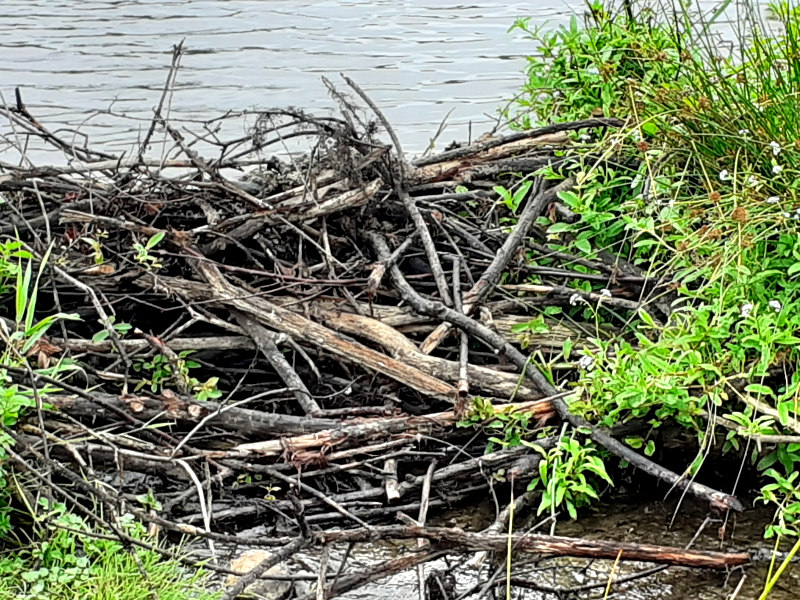
shelter under a large oak which was a little way back from the track. Then, despite the pouring rain, he was able to point out another four Purple Emperors feeding on sap runs. The group then turned round and went to inspect the dam at the bottom of the nearby hammer pond. The height of the water had been raised by about a foot, thanks to the building skills of the resident beavers. They had started with sticks and branches, then put stones and bricks on the higher side of the dam and lined it all with mud. Pigs have learned to dive and pick up swan mussels. Water Figwort, Water Forget-me-not, Water plantain, Marsh Woundwort and Greater Bird’s-foot-trefoil, all plants of wet habitats, were seen here.
A Great Crested Grebe was on its nest and a Blue-tailed Damselfly was identified. Members then walked back to the café for a hot drink and some cake. At this point, some of the party set off back home. But 8 serious walkers set out again on a circular walk which passed the ruins of the original Knepp Castle, with its motte, bailey and keep. A small herd of Exmoor ponies with 3 foals was spotted. The River Adur has been restored to a more natural form, with meanders. Water plants seen here included Flowering Rush, Water-plantain, Purple Loosestrife and Arrowhead. The millpond was once the largest body of water in the south-east of England, but it has silted up. Water power was once used to drive hammers which could crush the ore and work the bellows for the 16th and 17th century iron works. A hide looked out over the millpond, where Cormorant and Gadwall were amongst the sightings. Finally, on the walk back, Trifid Bur-marigold was identified.