Sue White led a walk to look at fungi and slime moulds at Wildmoor Heath on the morning of Saturday 11 October. Meeting point was the reserve car park on the east side of Sandhurst Road at Crowthorne.
The walk started out southwards through woodland which was dominated by Oak, Sweet Chestnut and Birch, and dotted with tall Scots Pines. First sighting was a White Saddle Helvella crispa at the side of the path. Under a pine was a group of Brown Rollrims Paxillus involutus. They are poisonous, with the toxins building up over time. A tuft of one of the Scalycaps Pholiota was growing on a Sweet Chestnut stump. The upper specimens had dropped brown spores onto some of the lower ones. Other fungi found nearby included the large orange Rustgill Gymnopilus junioni, Sulphur Tuft Hypholoma fasciculare on pine and a Bay Bolete Boletus badius at the side of the track. It had pale yellow pores on the underside which stained blue-green when handled. It had been attacked by the Bolete Eater
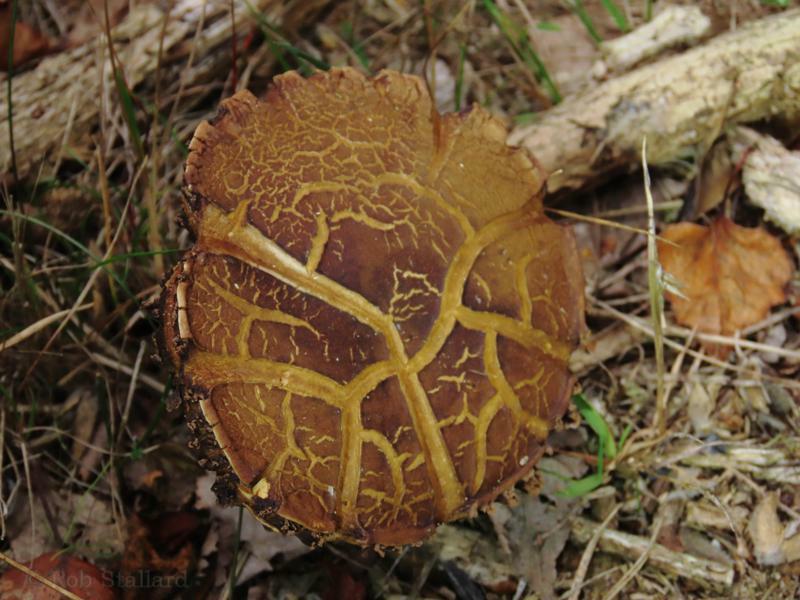
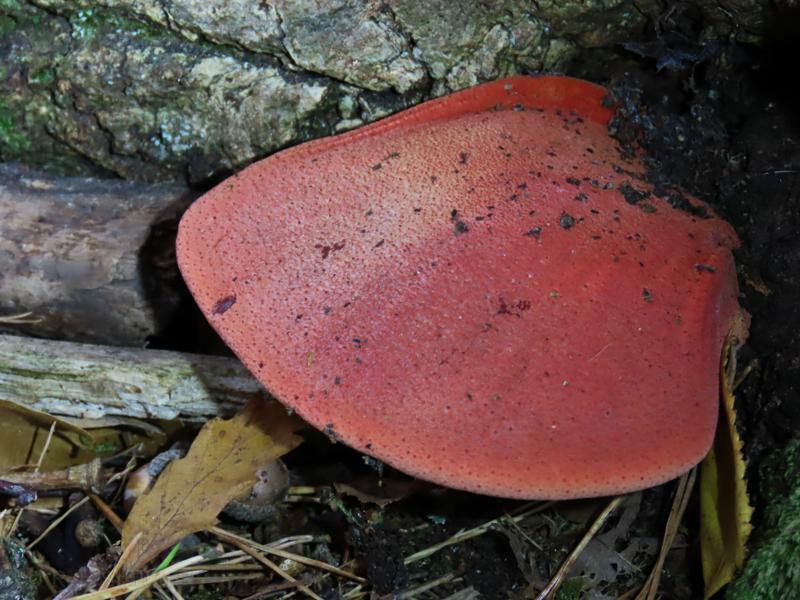
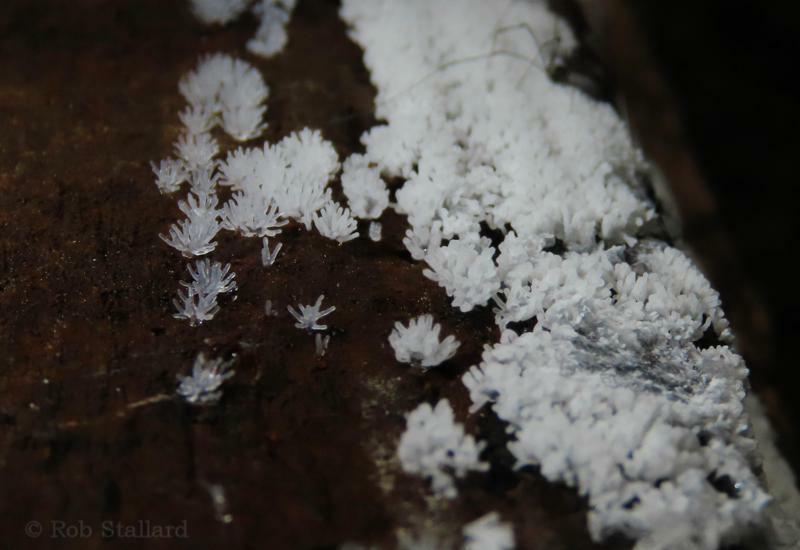
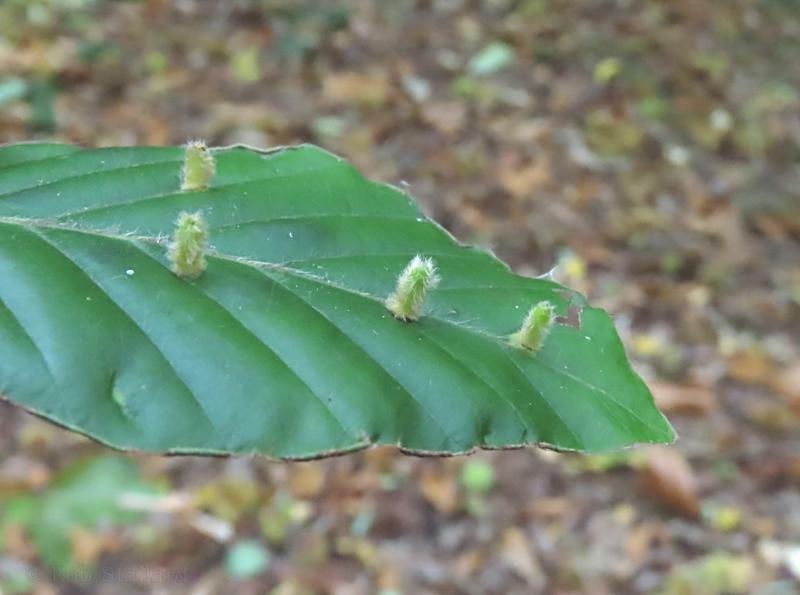
Hypomyces chrysospermus, a parasitic fungus which attacks Bolete fungi. It is white initially, then turns sulphur yellow. A Shaggy Scalycap Pholiota squarrosa, with scales on both cap and stipe (stem), was growing in the cleft of a tree trunk. It is a secondary parasite, attacking trees that have already been weakened by prior injury or infection. It can also grow saprophytically on dead wood. The cap of a poisonous Blusher Amanita rubescens was covered with remnants of its veil and it stained red when cut. A Birch Bracket Fomitopsis betulina had holes which had been bored by one of four or five possible species of beetle. The first of many Fly Agarics Amanita muscaria of the morning was seen. Plicatura crispa on a birch log had forked gill-like folds. Several buried cones were found which supported small colonies of Conifer Conecap Baeospora myosura. They are small tough fungi with crowded gills. Growing under pine was a small troop of cream-coloured fungi with small brown speckles which were identified as Spotted Toughshank Rhodocollybia maculata. Yellow Stagshorn Calocera viscosa was growing on rotting conifer wood. False Chanterelles Hygrophoropsis aurantiaca were dotted across the woodland floor. The Common Rustgill Gymnopilus penetrans was found on rotting conifer wood. A bright yellow fungus under pine was identified as Dyer’s Mazegill Phaeolus schweinitzii. The underside showed a labyrinthine pattern of pores. An oak leaf had Spangle Galls, made by the wasp Neuroterus quercusbaccarum, Silk Button galls made by the wasp N. numismalis, and a Pea Gall on a vein. Earlier in the walk, a Beech leaf had been found with Hairy Beech Galls Hartigola annulipes. The route followed the boundary between the woodland and the heathland. A boardwalk had been deconstructed, with single wooden sleepers bridging wet parts. On the underside of one of the sleepers was the white slime mould Coral Slime Ceratiomyxa fruticulosa. Seen through a hand lens, the structures resembled corals or sea anemones. Before turning right onto a track across the heathland, the group stopped to inspect a bright red Beefsteak Fungus Fistulina hepatica at the base of an oak tree. Both Brown Birch Bolete Leccinum scabrum and Orange Birch Bolete L. versipelle were found near the track. Brown Birch Bolete had scabers (scales) on its stem. Orange Birch Bolete turned first dull pink, then grey/black when cut. The next part of the walk followed a narrow path up towards the top of a ridge. The reindeer moss Cladonia portentosa (actually a lichen) was found here, as was C. fimbriata. On the walk back to the car park, the group added Birch Milkcap Lactarius tabidus, Cracking Bolete Xerocomellus chrysenteron, Common Earthball Scleroderma citrinum and Tawny Grisette Amanita fulva to the sightings list. The latter species had distinctive striations at the edge of its cap. Brittlegills of a number of different colours were found during the morning, including purplish
pink, grey and greenish grey. Peeling off the cuticle from the fleshy cap of a greenish grey specimen
revealed that it was Powdery Brittlegill Russula parazurea.