On Wednesday 19 February, on his fourth attempt, Rob Stallard led a walk round Savernake Forest, which lies between Hungerford and Marlborough. In the three preceding years, the February mid-week walk had had unsuitable weather – either rain, strong winds or both. This time, there was a little drizzle and a band of light rain band passed through, but then the sun came out. Before starting the walk, Rob told members a little about the Forest. It holds many records. It has the longest tree-lined avenue in Britain (the Grand Avenue which is 4 miles long and follows the route of a Roman Road), it has the greatest concentration of veteran trees anywhere in Europe, its forest designation dates back to Saxon times, and it is the only privately owned forest in England (owned by the Earl of Cardigan who is the 31st hereditary Warden of the Forest in a direct line to the first warden). Safernoc is first mentioned in 934. It is managed as a commercial undertaking by Forestry England and there are large stands of non-native conifers. The interesting parts are to be found along the edges of the forest, along ancient tracks and in some boggy areas. The soil is a thick layer of ‘Clay with Flints’ which formed between 23.03 million and 11.8 thousand years ago during the Neogene and Quaternary periods. The bedrock is Chalk, laid down 86 million years ago. Due to the poor, infertile soil, the Forest has escaped cultivation. This has also led to slow tree growth, so the veteran trees may have lower girth than might have been expected for their age. The oldest tree is believed to be the 1,100 year old 11 metre circumference ‘Big Belly Oak’. It is located beside the busy A346 Salisbury Road. Measures are now taken to clear a halo from around the veterans to reduce competition for light and nutrients. Cattle have been introduced into some areas to create open meadows. Savernake has SSSI status (1971) primarily for rare lichens found on the bark of the older trees. There are also rare fungi and mosses.
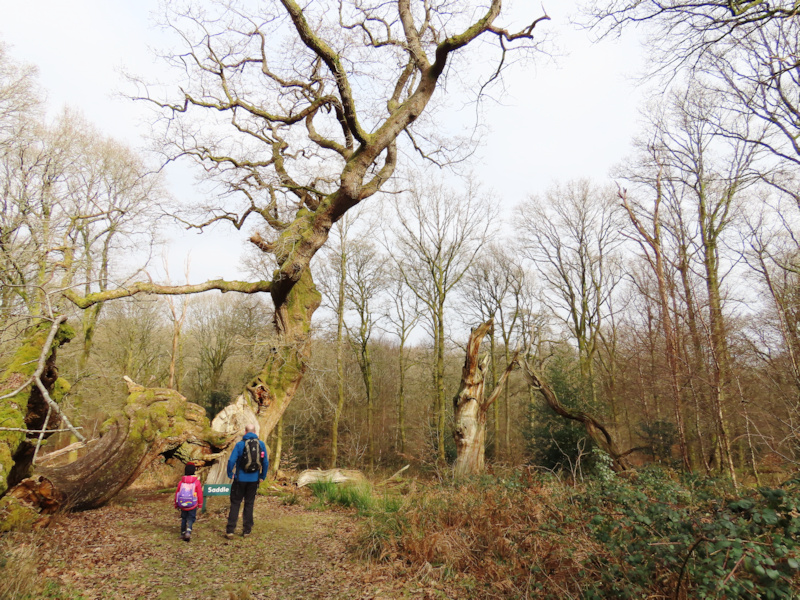
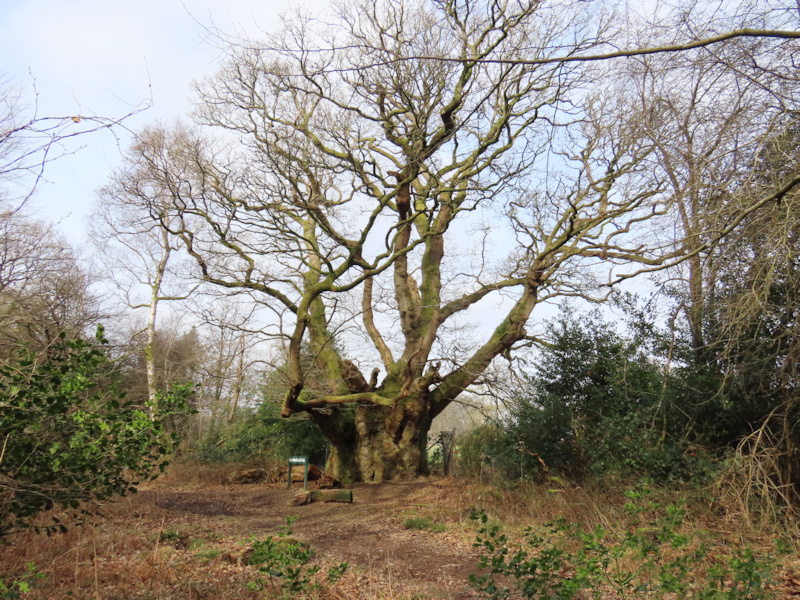
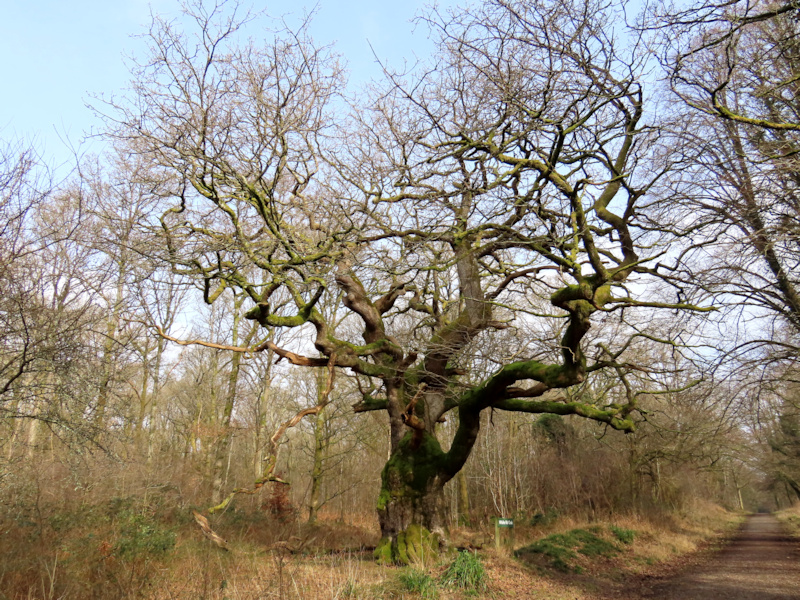
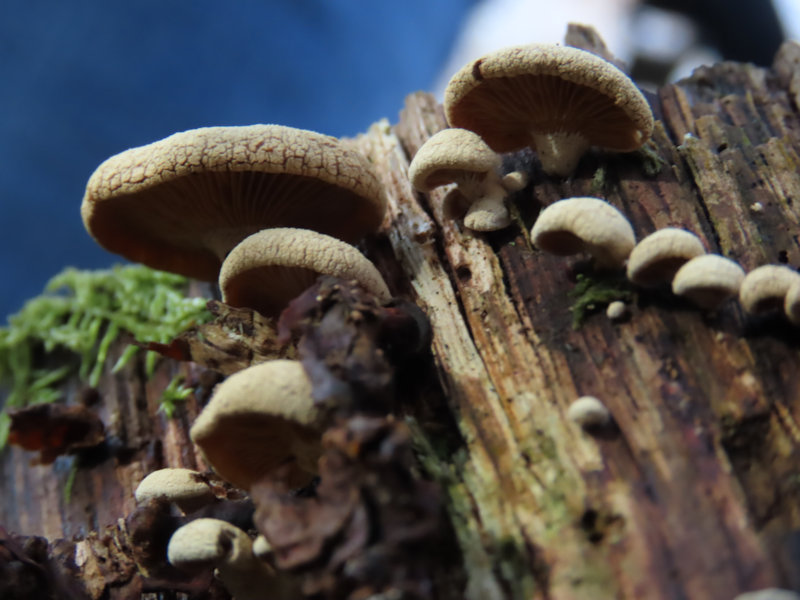
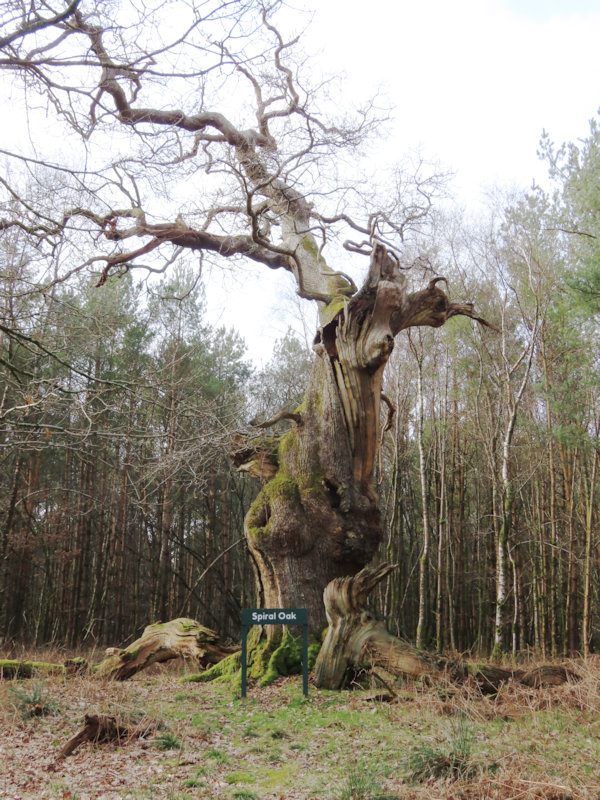
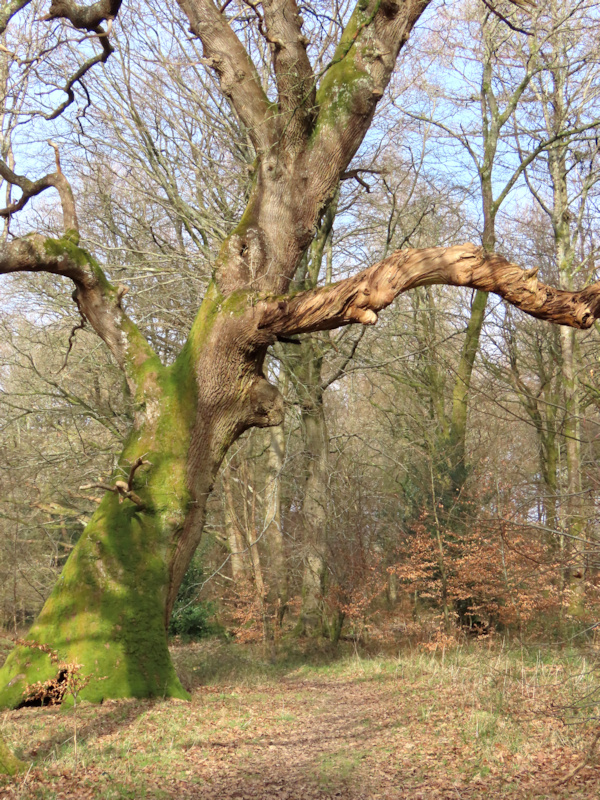
Starting point for the walk was a small, unmarked car park at the side of Grand Avenue. The group set off in a westerly direction along Long Harry, one of the original winding tracks through the Forest. The Forest was dominated by oak trees and relatively open, with fallen oak leaves carpeting the floor and no sign of Bluebells. Wood Spurge plants were seen next to the track. A big old oak on the left of the track was covered in bright green moss. According to Rob’s tree inventory, it was Oak 442 with a circumference of 6.69 m. A Nuthatch was heard and a Song Thrush was singing. Hairy Curtain Crust Stereum hirsutum was found on a fallen log. The route then turned to the right and passed a big fallen tree where a Treecreeper was foraging on the bark. The path led to the Saddle Oak. A giant limb had fallen from this big old oak and it no longer looked as saddle-like as it once did. Turning left then right, the route continued northwards along Church Walk to Old Paunchy, which has a circumference of 8 m and is probably about 700 years old. It has Polypody ferns growing on some of its limbs. Two noisy male Blackbirds were fighting, jumping up into the air and flapping their wings at one another. A female was spotted nearby. After reaching the White Road a detour was made to see the next named tree – the Cathedral Oak, with a circumference of 10.15 m and a height of about 25.8 m. It is at least 1000 years old and is probably the second oldest tree in the Forest. It stands next to the boundary fence, with Savernake Hospital on the other side. After retracing their steps for a short distance, the group walked south-westwards along White Road passing Young Paunchy on the way to the White Road Oak, which has a circumference of 6.75 m. The route then turned left, and continued south- eastwards to the Great Beech, which has a circumference of 5.23 m. Beechmast Candlesnuff fungus Xylaria carpophila with a single sporing tip was found on the ground below the tree. The walk continued along Great Lodge Bottom and Great Lodge Drive, then turned into a more open grassy area. Seen here was the Bruce Oak, with a circumference of 6.4 m. A Red Kite flew overhead and a Buzzard was also seen in flight. A specimen of the Oak Cherry Gall Cynips quercusfolii was found on an oak leaf. An old Hawthorn and a Hart’s-tongue Fern were noted. On the other side of the valley, a Roe deer with a youngster at its side watched the walkers for a while, then moved quietly away. The route took a detour south of Great Lodge Drive to see the Spiral Oak and then passed a Leaning Oak and a Monkey-puzzle Tree on the way back to the parked cars on Grand Avenue. Most of the group then went for lunch at the Bear at Hungerford.
Attended by 9